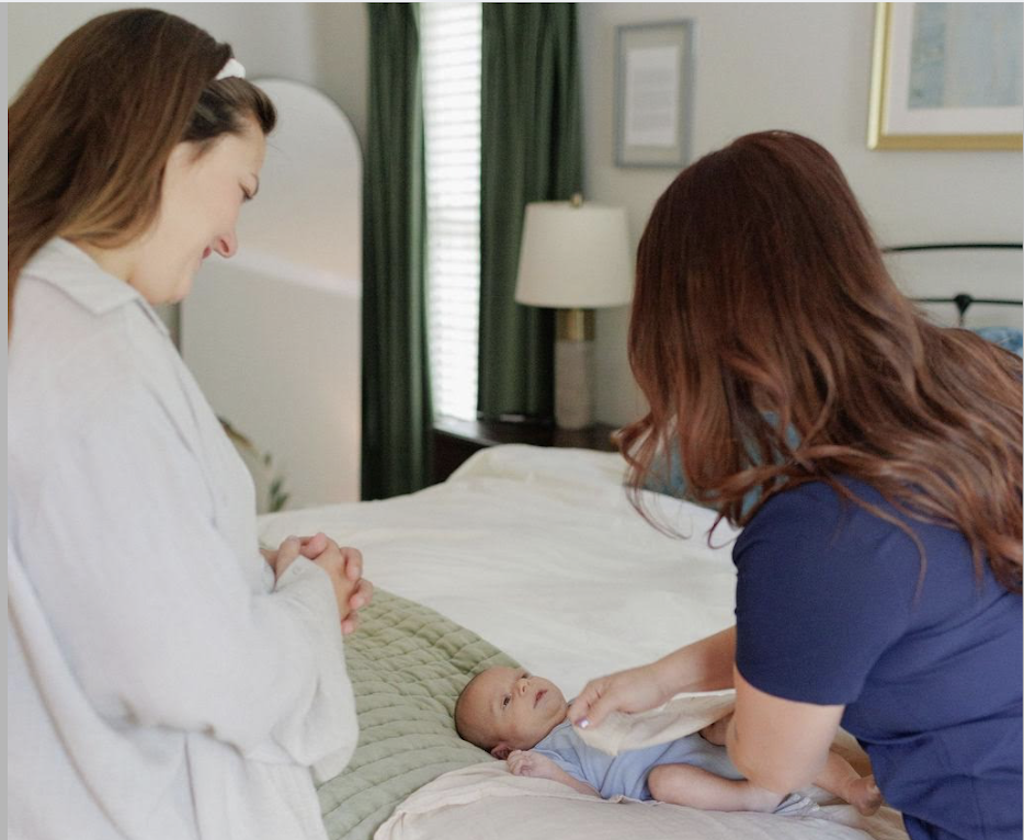
For parents navigating the first weeks after birth, overnight newborn care can be a vital support. However, baby’s weight and feeding patterns are still stabilizing, nursing and bottle feeding are getting established and postpartum healing is very much in progress. During this vulnerable time, the lines between medical and non-medical care might get blurry. For this reason, RN-Coordinated Newborn Care is the safest option for families; a license Nurse directs care alongside a newborn care provider.
Let Mommy Sleep offers every family in our network the RN + NCS model: a Registered Nurse conducting a dedicated postpartum home visit during the first week, and then working in direct coordination with the overnight Newborn Care Specialist. We call this RN-Coordinated Newborn Care, and it is the only care model of its kind offered by a nationally operating newborn care network. Two professionals with one integrated care plan ensures that families receive clinical and hands-on care so postpartum support is never “out of scope”.
This article explains why that coordination matters, how it works in practice, and why we believe it sets the standard for responsible newborn and postpartum support.
| Registered Nurse | Newborn Care Specialist | |
|---|---|---|
| When | First week, daytime visit | Overnight, 10pm–6am |
| Focus | Parent recovery + newborn clinical assessment | Infant feeding, sleep, soothing |
| Screens for | PPD, infection, healing | Feeding issues, behavioral cues |
| Available after visit | Phone, app, text, email | During shift |
| Credentials | Licensed RN | NAPS certified, Cribs for Kids |
The problem with overnight care delivered in isolation
A skilled Newborn Care Specialist, someone trained in infant feeding, safe sleep, soothing techniques, schedule building and newborn behavior, brings tremendous value to a new family. But newborn care specialists and postpartum doulas are not medical providers. They are not trained to assess postpartum recovery, flag early signs of infection, screen for postpartum mood disorder symptoms or give medical advice.
Equally, a Registered Nurse conducting a single postpartum home visit provides clinical assessment and peace of mind, but isn’t present overnight to troubleshoot latching, attempt different types of soothing techniques, or when parent questions come up at 3 a.m.
Delivered in isolation, each is valuable. Delivered together, they cover the full picture of recuperation, health and confidence for parents.
What Is RN-Coordinated Newborn Care?
In the Let Mommy Sleep model, every family can receive a postpartum home visit from a Registered Nurse during the first week home. This isn’t a check-in call or a telehealth appointment. It’s an in-home clinical visit conducted by an RN who:
- Assesses the postpartum parent’s physical recovery
- Evaluates the newborn’s weight, feeding, skin tone, umbilical cord and overall presentation
- Screens for postpartum mood and anxiety disorders
- Answers clinical questions that a caregiver cannot (and shouldn’t) address
- Documents findings through our in-house app and communicates them directly to the family’s overnight NCS
That last point is the hinge of the entire model. The RN doesn’t visit and disappear. She hands off relevant clinical context to the overnight specialist: feeding concerns, weight trends, anything flagged during the visit that the NCS should monitor through the night. Then the RN remains available to the family and caregiver via phone, app, text or email for any ongoing questions.
Timing matters because the first week is when the most significant clinical changes happen. Milk supply and feeding is getting established and incision or perineal recovery is in its most vulnerable phase. Early intervention yields better results and having an RN involved during this window can be the difference between catching something early and managing a crisis.
Early intervention example: when breastmilk comes in around day 2-4, inflammation of the breast might occur. If not managed properly, what is a common condition can become serious, leading to infection or hospitalization.
What the NCS brings to the partnership
A Newborn Care Specialist certified through our network:
- is Newborn and Postpartum Support (NAPS) certified
- holds a Cribs for Kids Safe Sleep certificate
- is vaccinated
- provides infant feeding support to all parents; breast, bottle, formula, pump and milk storage assistance and more
- does all swaddling, soothing and schedule development (at parents request)
- uses and educates on evidence-based practices only
- is experienced in the care of twins
The NCS is present for the hours acting as the night nanny typically from 10 pm to 6 am. The night nanny cares for single babies and twins throughout the night; monitoring and providing all care.
Because the newborn caregiver received a “handoff” from the RN, she isn’t starting from zero. She knows if there was a feeding or other concern about the baby at the visit and knows the parent’s recovery status. The overnight shift begins with clinical context, not guesswork.
How the coordination actually works
The RN and NCS are not strangers who happen to work for the same company. They are professionals in active communication, both connected to the family’s care coordinator at Let Mommy Sleep.
This isn’t a complicated system. It’s what good care coordination looks like in any healthcare-adjacent setting: two professionals who know what the other has observed, working in sequence so nothing falls through the cracks.
Families with pediatricians and OBs who want to stay informed can also share visit notes. Since families should always defer to their primary care physicians, the model is designed to complement (not compete with) your existing medical relationships.
Why this matters more than most families realize
New parents are in one of the most vulnerable periods of their lives, physically and emotionally. Recuperation, hormones and sleep deprivation can also affect the ability to know “what’s normal” versus when intervention might be helpful. What are typical Baby Blues vs. PPD for example, is a common question.
In that environment, having two professionals who know each other, know the family, and are actively communicating is not just a good idea, it’s a structural safeguard.
The newborn care industry has grown rapidly over the past two decades without consistent oversight, licensing requirements, or professional standards. Families often have no way to evaluate the qualifications of the person they’re inviting into their home for overnight care. Our model was designed explicitly to address that gap: trained and vetted specialists working within a supervised, medically-adjacent framework.
We have written about this more extensively in The State of Newborn Care in the United States, a policy paper examining the gaps in oversight and the case for standardization across the industry. If you’re a healthcare provider, hospital system, or policy researcher, we encourage you to read it.
Who this model is designed for
The RN + NCS model is appropriate for any family bringing a newborn home, but it is particularly valuable for:
- First-time parents who have no prior reference point for what is “normal”
- Families with multiples (twins, triplets) where complexity is inherently higher
- Families where the birth parent has had a cesarean section, perineal trauma or had a complicated delivery
- Families with a history of postpartum mood disorders
- Families whose newborn had a NICU stay or is being monitored for any clinical concern
- Parents who want to bridge the 6 week postpartum gap between birth and the first OB/GYN visit.
Care is available in all Let Mommy Sleep territories. Families can find a specialist in their area or contact their local territory directly.

For newborn care professionals
If you’re a practicing newborn care specialist, night nanny or postpartum doula and the model described here is new to you, that is not unusual. Most practitioners work independently, without a clinical partnership structure. That is not a failure of course, it simply reflects where the industry currently is and different models of care.
If you want to practice within a medically-adjacent, coordinated care framework, or if you are pursuing or hold NAPS certification, we encourage you to explore Let Mommy Sleep’s professional network.
Interested in bringing RN-Coordinated Newborn Care to your market? Learn how the Let Mommy Sleep licensing model works at letmommysleepfranchise.com.
Let Mommy Sleep operates in 26 territories across the United States. To find care in your area, visit Find a Newborn Care Specialist. To learn more about professional certification, visit Newborn Care Certified.
Frequently Asked Questions
Does this work for twins?
Yes. Twin overnight care is a specialty, and the RN visit is especially valuable for multiples given the complexity of feeding two newborns and extra monitoring preemies may need. Post-birth recovery is also often more complex after twins, and things like c-section recovery, suture care and “what’s normal” in terms of blood loss and recuperation often become clinical topics. It is appropriate for a Nurse, rather than a non-licensed caregiver to provide an in-home visit when parents are just home from the hospital.
How is this different from using a postpartum doula or newborn care provider?
A postpartum doula provides emotional support, household help and general newborn and postpartum guidance. A newborn care specialist is specifically trained in infant care. The addition of an RN in our model adds an evidence-based, medical layer that neither role provides on their own.
Why do I need this if I already have a pediatrician visits?
The RN assesses the postpartum parent’s recovery and screens for mood concerns and postnatal healing which are things a pediatric appointment typically doesn’t cover. Additionally, the visit involves teaching daily like like swaddling, diaper changing, creating a safe sleep set-up and more. The RN visit complements your pediatrician, it doesn’t replace them, and you should always defer to the primary care physician.
When should I book if I’m due next month?
As early as possible. While Let Mommy Sleep is usually able to handle last minute requests, but we find that parents feel better having a schedule in place before baby arrives. The RN visit can happen anytime during the day or evening in the first week or so home from the hospital and this specific date can be flexible.
