Newborn Care Specialists by Let Mommy Sleep

Where Registered Nurses and certified newborn care specialists work as one team.

Resources

  • Newborn Care Specialist vs Night Nanny vs Postpartum Doula: What’s the Difference?

    Newborn Care Specialist vs Night Nanny vs Postpartum Doula: What’s the Difference?

    Night nanny. Newborn care specialist. Baby nurse. Postpartum doula. These are caregiving descriptions that often overlap and are not legally regulated. Anyone can use any of them without training, certification or experience. For families trying to hire overnight newborn care, the confusion can be real; they simply want a trustworthy, safe individual to help care for their babies. For caregivers trying to build professional credibility, the absence of clear standards can be a genuine obstacle. This page explains what each title actually means, where they overlap, where they differ, and most importantly what the verifiable distinctions are.

    The Short Answer

    The titles don’t always matter.

    Night nanny, newborn care specialist, baby nurse and postpartum doula are all unregulated titles in the United States. Parents might these terms interchangeably to mean “someone who helps after baby arrives,” while a caregiver can use any of them regardless of training or experience. The only distinction that families and employers can actually verify is whether the caregiver holds a recognized credential.

    What Is a Night Nanny?

    A night nanny is a caregiver who provides overnight support to newborns and their families, typically from 10pm to 7am. The work includes feeding, diapering, soothing, safe sleep implementation and allowing parents to rest overnight, and also providing evidence based education.

    The title “night nanny” has no legal definition in any U.S. state but is a widely accepted term for overnight caregiver. It may describe a highly trained, certified professional or someone with no formal training at all.

    What Is a Newborn Care Specialist?

    A newborn care specialist is a professional who focuses specifically on newborn care typically in the home setting during the first weeks or months after birth. The role may include overnight care, daytime care, parent education, feeding support and instilling healthy sleep habits.

    The title “newborn care specialist” has no legal definition or regulatory standard in the United States. It may describe a highly trained certified professional or someone with no formal background or experience. The title alone does not distinguish between the two.

    What Is a Baby Nurse?

    Baby nurse is one of the most potentially misleading titles in the newborn care space. In most U.S. states the word “nurse” is legally protected meaning only Registered Nurses and Licensed Practical or Vocational Nurses holding active clinical licenses can legally call themselves nurses. A “baby nurse” who is not a licensed RN or LPN is using the term colloquially, not as a clinical designation.

    Families should ask: does this person hold an active nursing license, or are they using “nurse” to describe their experience level? The distinction matters if you’re expecting clinical oversight, medication management, or postpartum medical assessment.

    At Let Mommy Sleep, all Registered Nurses and Licensed Practical Nurses hold active clinical licenses in addition to NAPS certification. The RN role involves in-home postpartum visits during the first week home, clinical oversight built into the care system from day one.

    What’s a Postpartum Doula?

    A postpartum doula provides emotional, practical and informational support to families during the postpartum period. The focus is typically on the mother’s recovery, family adjustment and newborn care education rather than overnight infant care specifically. This can include household tasks and help with care of siblings. Postpartum doula training programs have helped professionalize the field and include full-spectrum care from prenatal to birth and postpartum phases. While widely respected and internationally used, the title still remains largely unregulated and there are no requirements to practice in the home.

    The NAPS Night Doula Certificate was specifically designed to address in-home overnight care skills and responsibilities, during the critical first weeks home with baby.

    What Is a NAPS-Certified Night Doula or Newborn Care Specialist?

     A NAPS-certified night doula or newborn care specialist is a caregiver who has completed the NAPS Night Doula Certificate — the evidence-based credential developed by Let Mommy Sleep and required across 26 territories nationwide, verifiable on the National Night Doula Registry. See exactly what NAPS certification covers and requires

    Let Mommy Sleep RN's and newborn care specialists

    The Let Mommy Sleep Standard

    At Let Mommy Sleep, every caregiver, regardless of title, holds the NAPS Night Doula Certificate, and Registered Nurses and specialists work together through RN-Coordinated Newborn Care, with an RN handling the first week home visit before handoff to the overnight specialist. See exactly how the RN + NCS model works

    Find a certified newborn care specialist through Let Mommy Sleep

    Side by Side Comparison

    Here is how the titles compare on the factors that actually matter:

    • Night nanny — Unregulated title. No standard training requirement. May or may not be certified.
    • Newborn care specialist — Unregulated title. No standard training requirement. May or may not be certified.
    • Baby nurse — Unregulated colloquial title. “Nurse” may or may not indicate an active clinical license. Confirm directly.
    • Postpartum doula — Various certification programs available. Focus typically on maternal support rather than overnight infant care specifically.
    • NAPS-certified night doula / newborn care specialist — Completed NAPS Night Doula Certificate. Infant safe sleep certified. Background screened. Vaccinated. Listed on National Night Doula Registry. Verifiable.
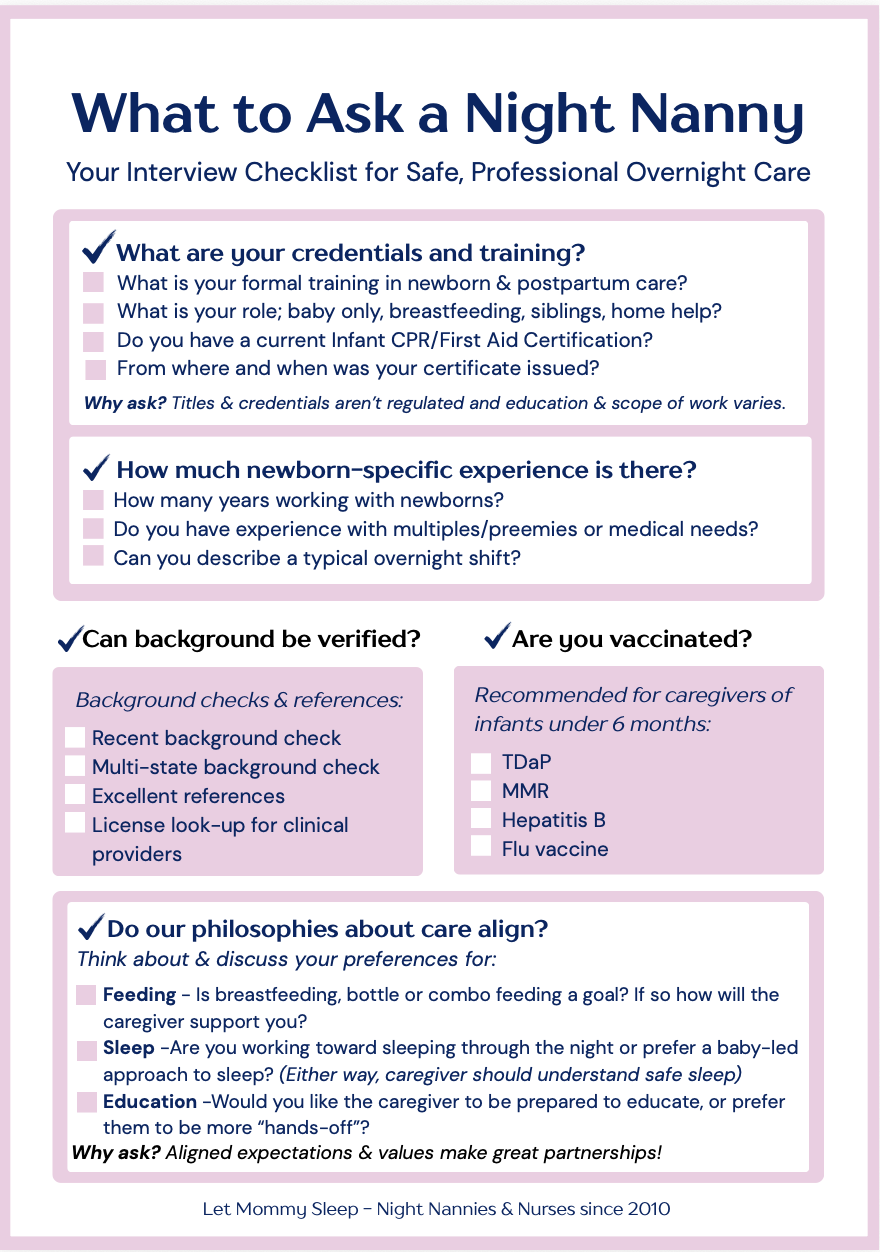
    checklist of questions to ask a night nanny, postpartum doula or newborn care specialist

    What Should Families Actually Ask?

    Whatever title a caregiver uses, the questions that actually verify their qualifications are the same. → See the full interview checklist for hiring a night nanny or newborn care specialist

    Additional questions about philosophy, thoughts on infant sleep training and experience can also help determine if the caregiver is a personality fit for your family.
  • Certificación de Especialista en Cuidado de Recién Nacidos en Español: NAPS Night Doula Certificate

    Certificación de Especialista en Cuidado de Recién Nacidos en Español: NAPS Night Doula Certificate

    Newborn Care Specialist Certification Is Now Available in Spanish

    The newborn care profession has a language gap in evidence-based care, and the caregivers best positioned to serve Spanish-speaking families are often native Spanish speakers themselves. Until recently, the only pathways to professional certification in this field were available exclusively in English.

    The NAPS Night Doula Certificate — the evidence-based standard for newborn care specialists and night nannies in the United States — is now available in Spanish, making it the first and only nationally recognized newborn care certification program offered in both English and Spanish.

    Certificación de Especialista en Cuidado de Recién Nacidos en Español

    Why Spanish-language certification matters

    The United States has a large and growing Spanish-speaking population, concentrated in markets like Los Angeles, Houston, Miami and the Washington DC metro area. These are cities where Let Mommy Sleep operates and where demand for overnight newborn care from Spanish-speaking specialists is real and underserved.

    For Spanish-speaking caregivers, the barrier has never been skill or commitment, it has been access. A certification program available only in English effectively excludes experienced, dedicated practitioners from the credential that families and networks increasingly require. And for bilingual night nannies or newborn care specialists who already understand how to provide excellent care, updated recommendations from evidence-based organizations like the American Academy of Pediatrics, might be more accessible in Spanish. Either way, exclusion has real consequences for caregivers who can’t verify their training, for families who can’t find culturally and linguistically matched care and for an industry that is built on serving all families.

    The Spanish-language NAPS Night Doula Certificate removes that barrier directly.

    What the Spanish certification covers

    The Spanish-language NAPS Night Doula Certificate is a full translation of the English curriculum, not a simplified version and not an adapted summary. It covers the same evidence-based content required of all caregivers in the Let Mommy Sleep network:

    • Newborn and postpartum care fundamentals
    • Infant safe sleep standards aligned with AAP guidelines
    • Breastfeeding and bottle feeding support
    • Swaddling, soothing and daily care
    • Care of twins and higher-order multiples
    • Bereavement doula skills
    • Home organization newborn care settings
    • Safety and first aid basics

    Upon completion, caregivers receive the same certificate and are listed on the National Night Doula Registry, the only verifiable public directory of certified newborn care specialists in the United States, regardless of which language they completed the program in. The credential is identical.

    Human translation, not AI

    The Spanish-language curriculum was translated by Patty Grajales and her team at Careworks; professional humans and not AI-generated content. This distinction matters because safety, newborn and postpartum terminology requires precision. Nuance in instructional language affects comprehension and retention. AI translation of clinical content introduces errors that human review catches and corrects.

    The decision to invest in professional human translation reflects the same commitment to standards that defines the NAPS curriculum itself.

    The Let Mommy Sleep Spanish blog

    Let Mommy Sleep maintains a Spanish-language blog at letmommysleep.com/blog/category/en-espanol, a growing resource for Spanish-speaking families navigating newborn care, postpartum recovery and infant sleep. Posts are added regularly and cover practical guidance for the first weeks home with a new baby.

    For Spanish-speaking families in Let Mommy Sleep territories, the blog is a companion to the care itself — a place to find information in their language from the same network providing their overnight newborn care specialist.

    For Spanish-speaking caregivers

    If you are a Spanish-speaking newborn care specialist, night nanny, postpartum doula or night doula looking to formalize your training with a nationally recognized credential, the NAPS Night Doula Certificate in Spanish is the direct path.

    Enrollment is available at newborncareacademy.teachable.com/p/clases-en-espanol. No prior certification is required. The full certification costs $349 and is self-paced and available entirely online.

    Upon completion you are listed on the National Night Doula Registry and eligible to apply to the Let Mommy Sleep network, which operates across 26 territories including Los Angeles and areas through Texas, markets with significant Spanish-speaking communities and demand for bilingual overnight newborn care.

    For families seeking Spanish-speaking newborn care

    To find a Let Mommy Sleep specialist in your area, visit Find a Newborn Care Specialist. Let Mommy Sleep territories serve Spanish-speaking families and can connect you with bilingual caregivers where available.

    Certificación disponible en español

    La certificación NAPS Night Doula Certificate está disponible en español en newborncareacademy.teachable.com/p/clases-en-espanol. No se requiere experiencia previa. El costo de la certificación completa es de $349 y está disponible en línea. Al completar el programa, recibirás un certificado descargable e imprimible y serás incluida en el Registro Nacional de Doulas Nocturnas en newborncarecertified.com.

    To learn more about becoming a certified newborn care specialist, visit How to Become a Newborn Care Specialist. To learn more about the NAPS Night Doula Certificate, visit Newborn Care Certified.

  • What Does a Newborn Care Specialist Cost?

    What Does a Newborn Care Specialist Cost?

    If you’re researching newborn care specialists for the first time, the range of rates you’ll encounter can be surprising and confusing. A night of overnight newborn care might cost $200 or it might cost $600, and both quotes could be entirely legitimate based on geography, length of time overnight or experience level of the caregiver. Understanding why rates vary so much is the first step to evaluating what you’re actually getting for the price.

    smiling newborn care specialist and baby to show how much newborn care costs.


    This article covers what newborn care specialists typically charge, what drives the variation and what families and prospective newborn caregivers should know about how this profession is compensated.

    What newborn care specialists typically charge

    Overnight newborn care, typically an 8 to 10 hour shift running from approximately 10 pm to 6 or 7 am, generally ranges from $300 to $450 per night in most U.S. markets. Rates at the higher end of that range reflect more experienced specialists, twins or multiples care or markets with a higher cost of living.

    In California for example, rates are notably higher across the board, often ranging from $550 to $700 or more per night. This reflects 3 factors: cost of living, a market with high demand that makes higher rates the norm and a concentration of experienced newborn care specialists able to charge a premium for their experience and excellent reputation.

    Rates are also higher for:

    • Twins and higher order multiples: the complexity of simultaneous care, feeding coordination and schedule management for two or more infants commands a premium. In some cases, two specialists work with triplets or higher order multiples which means paying 2 providers for 1 shift.
    • Experience and specialization: a night nanny or newborn care specialist with five or ten years of experience and a track record with high-need newborns will charge more than someone new to the field. Learn How to Become a Newborn Care Specialist
    • Licensed Nurses: Families can expect that licensed Registered Nurses, Licensed Practical Nurses or Licensed Vocational Nurses receive a higher rate of pay as they are providing care in a clinical capacity.
    • Shorter engagements: some caregivers charge a premium for single-night or very short-term bookings versus multi-week packages.

    Why independent practitioners can charge significantly more

    This is something families often don’t anticipate. A highly experienced independent newborn care specialist or night doula may charge $500 to $600 or more per night. As someone who has built a strong reputation and works entirely on their own, these rates reflect a real constraint, which is that independent specialists typically take only four to six clients per year.

    Because an NCS works overnight and needs adequate recovery time between engagements, a full client commitment occupies weeks of their schedule. An independent practitioner with strong demand and limited availability prices accordingly. If you’re working with an independent night doula at the top of their market, you are paying for scarcity as much as skill.

    This is a meaningful difference from working through a network like Let Mommy Sleep, where rates reflect a structured service model, consistent standards and the coordination of an RN visit and care team, rather than the market rate of a single in-demand individual.

    What affects the total cost of care

    Beyond the nightly rate, families should factor in the length of the engagement. Most families use newborn care for two to 12 weeks, though some engage care for longer. A two-week engagement at five nights per week is a meaningful investment. Many families find that front-loading care in the first two to four weeks when sleep deprivation and recovery are most acute, and then tapering off is the most cost-effective approach.

    A nightly rate from an independent caregiver is typically care only. A nightly rate through a network like Let Mommy Sleep includes the coordination infrastructure, vetting, backup coverage and coverage if there are requested changes to the family schedule. Comparing rates without understanding what’s included can be misleading.

    If you’re expecting multiples, ask about twins pricing specifically. Some newborn care specialists charge a flat surcharge; others charge per-infant or bring in a second specialist for an additional fee.

    How much do newborn care specialists make?

    For night nannies or doulas considering this career, the compensation picture is genuinely strong. The challenge is the same as it is for any business however; building experience and establishing a reputation.

    A full-time newborn care specialist working consistently can earn $45,000 to $100,000 or more annually, depending on the area’s cost of living, experience and how many nights per week they work. Specialists in California and other high-cost markets, or those specializing in twins, often earn at the higher end of that range.

    The trade-off is the schedule. Overnight work requires adjusting sleep patterns and extended engagements can be physically demanding. Most experienced specialists are deliberate about how many clients they take, and build recovery time into their schedules.

    Sometimes newborn care is a supplement to another healthcare position. As Denise Iacona Stern, Founder of Let Mommy Sleep notes: “Many of our newborn care team work with us throughout nursing school, or are nurses that care for families when they have three to fours nights per week off from the hospital.”

    Working within a network provides more consistent client flow and removes the business development burden of finding clients independently. Working independently provides more control over rates, scheduling and client selection, but requires building and maintaining your own reputation and referral pipeline. Both are excellent ways to work.

    NAPS certification, the evidence-based standard for newborn care specialists, is required for all caregivers in the Let Mommy Sleep network and is increasingly expected by families doing their research. Certification through the NAPS Night Doula Certificate costs $349 and is a direct path to professional credibility in this field.

    Is a newborn care specialist worth the cost?

    That’s a question only families can answer for themselves, but it’s worth framing it honestly.

    The first two to four weeks after a baby comes home are among the most physically and emotionally demanding of a parent’s life. Sleep deprivation compounds these challenges. For parents without family or community support, access to professional overnight newborn care means access to physical and mental health recovery, education and the capacity to function safely during a legitimately difficult period.

    For families bringing home multiples, recovering from a complicated delivery, managing postpartum mood concerns, or navigating a NICU discharge, professional overnight care is less of a luxury consideration and more of a clinical one.

    There’s no getting around it, the question of cost is real and legitimate. The question of value depends entirely on what the alternative looks like for your family.

    How to find a newborn care specialist

    Let Mommy Sleep operates in 26 territories across the United States. All caregivers in our network are NAPS certified, vaccinated, background screened, and work within our coordinated RN + NCS model. To find care in your area, visit Find a Newborn Care Specialist.

    If you’re a caregiver interested in entering this profession, learn more about certification at Newborn Care Certified or explore the How to Become a Newborn Care Specialist guide.

    Rates cited in this article reflect general market ranges as of 2026 and will vary by territory, experience and individual practitioner. Contact your local Let Mommy Sleep territory for current pricing in your area.

    Are you an expert with information to share?
    We would love to hear from you.